
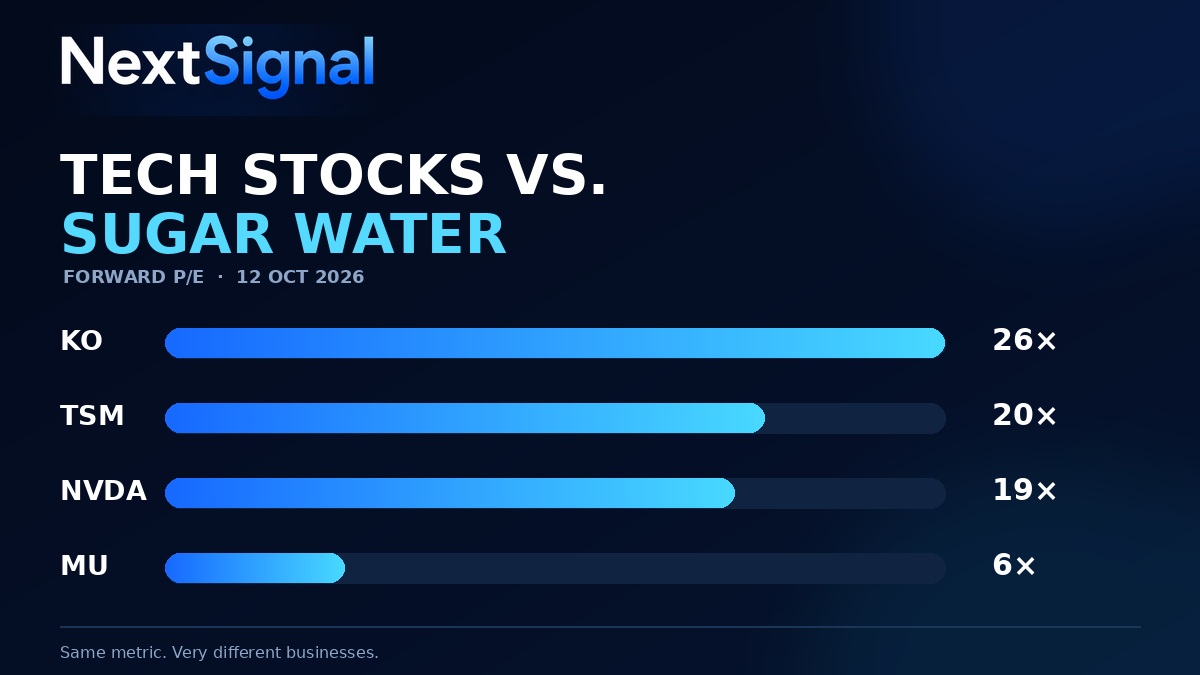
Coca-Cola at 26×, TSMC at 20×, Nvidia at 19× and Micron at 6× forward earnings: why P/E without growth and risk tells only half the story.
Four companies, one metric
At first glance, the comparison looks unusual. On October 12, 2026, Coca-Cola trades at roughly 26× forward earnings. TSMC is near 20×, Nvidia 19×, and Micron only 6×. The figures come from the same valuation source and use the same forward basis.
The market is therefore paying more for each expected dollar of Coca-Cola earnings than for three core companies in AI and semiconductor infrastructure. That does not automatically mean Coca-Cola is overvalued or tech is cheap.
Stability carries a premium
Coca-Cola offers a relatively predictable business, powerful brands, recurring demand and much lower share-price volatility. The company expects 9% to 10% comparable EPS growth in 2026. Investors pay a stability premium for that predictability.
Semiconductor companies currently offer much faster growth, but they carry different risks: pronounced cycles, heavy capital spending, technology shifts, geopolitical dependencies and very high expectations.
Growth can change the P/E quickly
TSMC makes the point especially clearly. Ahead of its results on October 15, analysts surveyed by Reuters expect roughly 50% year-over-year revenue growth and a 65% increase in net profit for the third quarter. When earnings grow that quickly, a share price can rise while the forward P/E still falls.
Micron's roughly 6× multiple shows the other side. The market recognizes today's memory boom but assigns a low multiple because memory pricing and margins have historically been highly cyclical. The discount is not a free opportunity; it is the price of cyclicality.
The better question
A P/E ratio is neither a quality score nor a complete verdict. It only tells us how much the market pays today for one expected dollar of earnings.
The more useful question is:
How much durable growth do I receive for this valuation—and what risk must I accept to get it?
That is the focus this week. TSMC's results will not only show how strong AI demand remains. They will also test whether that growth continues to justify the current valuation framework.
Sources: StockAnalysis / S&P Global Market Intelligence, Reuters on TSMC, Coca-Cola Q2 2026.
A stability premium for predictability and brand strength
Growth paired with cyclicality and high expectations
A low multiple reflecting memory cyclicality
The lowest P/E does not automatically win. What matters is how durable the growth is and how much risk the multiple reflects.
Valuation without growth is incomplete. Growth without a risk check is incomplete too.
These companies could also benefit from this theme.
TSM fully analyzed
AI score, trend, RSI and valuation at a glance.
Simulate investment
Calculate how an investment would have performed historically.
Discover NextSignal
All stocks with score, trend and AI assessment at a glance.
Related articles
Behind the Trader: Was würde mich umstimmen?
19 Positionen und eine entscheidende Frage: Welche Fakten würden eine AI-Investmentthese widerlegen?
Read articleKI-Boom auf dem Prüfstand: Wo bleibt die Rendite der Milliardeninvestitionen?
Nasdaq -4,5 % in der Vorwoche: Warum Metas AI-Investitionen und Cashflow diese Woche besonders wichtig werden.
Read article ETF
Ein ETF ist nicht automatisch ein Sicherheitsgurt: Versteckte Tech-Überschneidungen
Warum Value-, internationale und Halbleiter-ETFs das Klumpenrisiko sehr unterschiedlich beeinflussen – mit Marktbeispiel vom 15. Oktober 2026.
Read article