

Nearly three-quarters of surveyed companies report positive financial results from AI, yet fewer than one-third move beyond pilot projects. Why execution is becoming the critical bottleneck.
The pilot works — the rollout does not, yet
AI appears to have less of a demand problem than an execution problem.
A BearingPoint study reported by Reuters on October 1, 2026 reveals a striking gap: nearly three-quarters of surveyed companies already report positive financial results from AI. Yet fewer than one-third of projects move beyond the pilot stage, and only 13% of companies are on track with their AI initiatives.
That is not a contradiction. A contained use case can demonstrate value quickly. Turning a promising pilot into a reliable system for daily operations is much harder.
Where scaling gets stuck
Around 40% of respondents cite regulation as the main barrier. Another 34% point to the challenge of integrating AI into existing IT systems.
This is where the less glamorous work begins: data quality, permissions, security, governance, workflows and clear accountability. A demo is allowed to impress. A production system has to work every Monday morning.
What it means for the AI market
For investors, the distinction matters. Demand for computing power can remain strong while broad enterprise adoption progresses more slowly and unevenly.
Moving AI from pilot to production still requires compute, memory, networking and data-center infrastructure. At the same time, more value may accrue to companies that can integrate AI reliably into real workflows and make its economic benefit measurable.
The next phase may therefore be decided by more than the most powerful model. The winners will also need to turn technical capability into a repeatable, secure and economical process.
The signal
The current bottleneck is not interest in AI. It is scale.
Both can be true at once: the infrastructure buildout remains large, while practical adoption takes longer than many presentations suggest. Anyone analyzing AI should avoid confusing hardware demand with the speed of real-world deployment.
Source: Reuters, October 1, 2026
report positive financial outcomes
scale beyond pilot projects
are on track with AI initiatives
AI is already showing financial value. The key challenge now is turning successful pilots into reliable daily operations.
Markets like to discuss models and benchmarks. The economic bottleneck is increasingly integration and operations — where AI either becomes a scalable business or remains a pilot.
These companies could also benefit from this theme.
NVDA fully analyzed
AI score, trend, RSI and valuation at a glance.
Simulate investment
Calculate how an investment would have performed historically.
Discover NextSignal
All stocks with score, trend and AI assessment at a glance.
Related articles
 Strategy
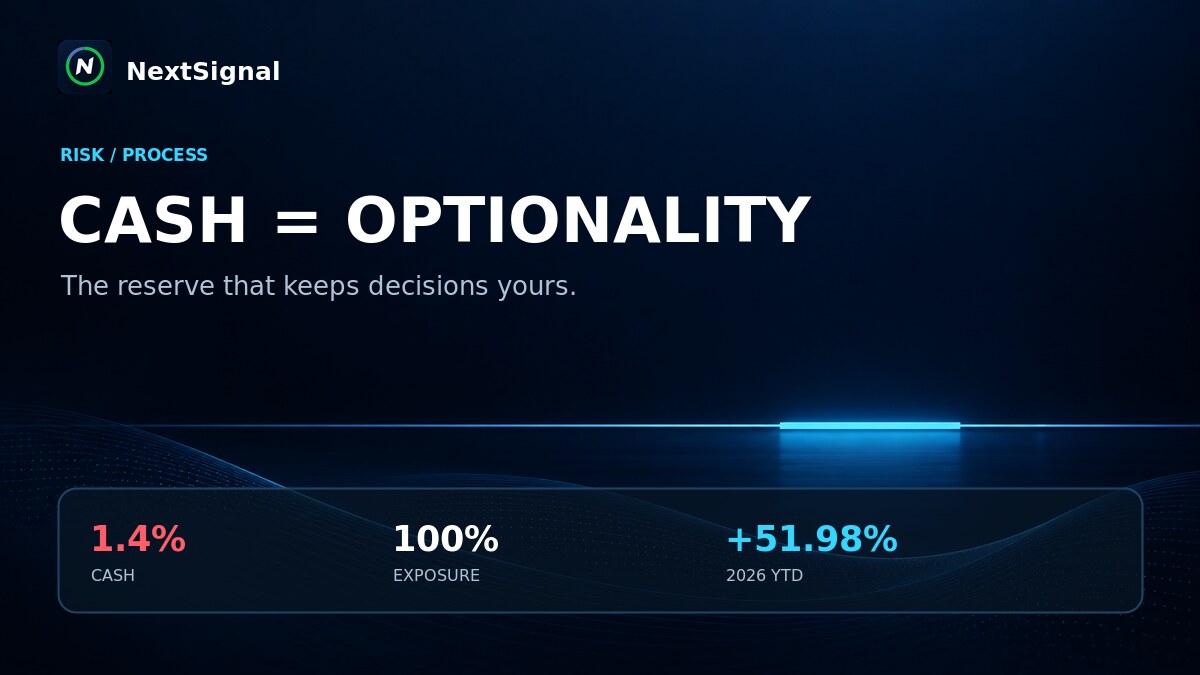
Cash ist keine Prognose: Warum Liquidität Handlungsfreiheit schafft
Das CaptMarvell-Portfolio liegt 2026 bei +51,98 %, hält aber nur rund 1,4 % Cash. Warum Liquidität kein Markt-Timing, sondern ein Prozesswerkzeug ist.
Read article AI & Technology
AI braucht nicht nur Chips: Wer liefert den Strom für den AI-Boom?
Rechenzentren könnten bis 2030 rund 945 TWh Strom verbrauchen. Vistra, Oklo und Vertiv stehen dabei für drei unterschiedliche Ebenen der AI-Energie-Infrastruktur.
Read article Stocks
Broadcom im Fokus: Wenn Strom zum neuen AI-Engpass wird
Morgan Stanley erwartet bis 2028 eine erhebliche Stromlücke bei US-Rechenzentren. Warum Broadcom vergleichsweise gut positioniert sein könnte – und wo das Risiko in der Lieferkette liegt.
Read article