
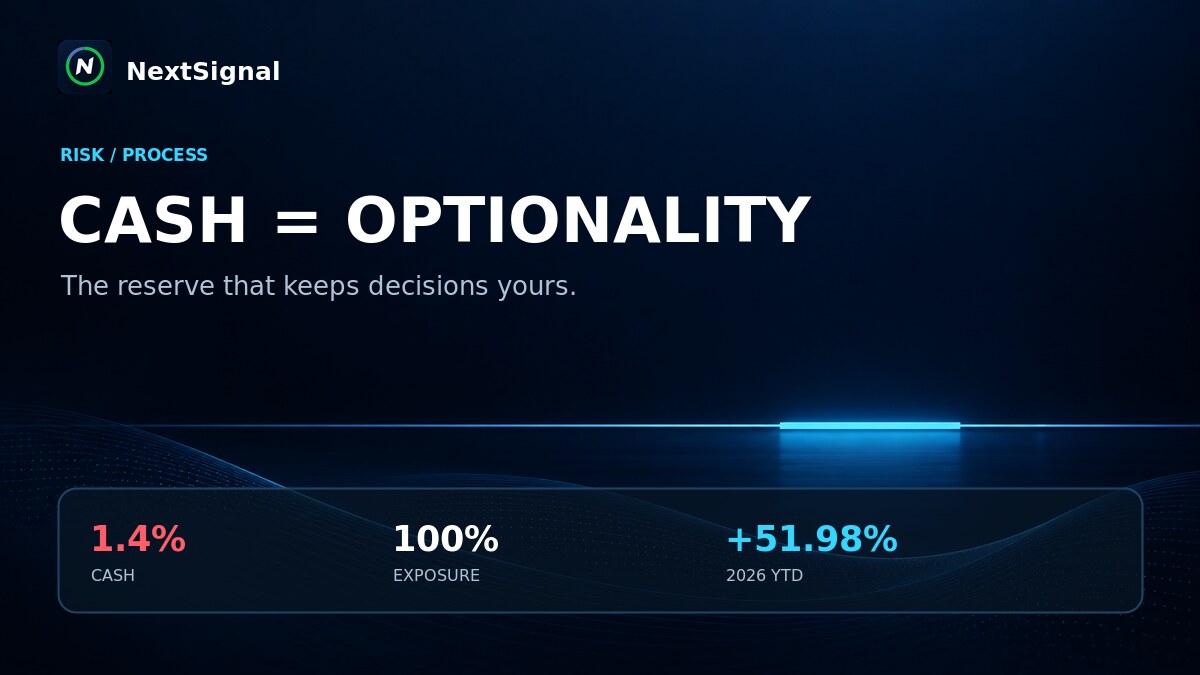
The CaptMarvell portfolio is up 51.98% in 2026 but holds only about 1.4% in cash. Why liquidity is a process tool, not a market-timing call.
The portfolio is currently up 51.98% in 2026. At the same time, cash has fallen to roughly 1.4%, with 100% market exposure.
That is not an alarm signal. But it is a clear process marker.
Strong performance does not prevent poor decisions
After a strong run, a nearly fully invested portfolio can feel efficient. Capital is working, winners are moving, and cash looks like a drag.
The problem only becomes visible when volatility returns. Without a reserve, an attractive opportunity can quickly turn into a decision under pressure: selling when you do not want to sell, or watching when you would rather act.
For me, cash is therefore not a forecast about the next correction. It is optionality.
Growth is being rewarded — but capital remains expensive
Underlying AI demand remains strong. At the same time, long-term US yields are close to multi-year highs. Reuters reported that the 10-year Treasury yield in early October was just below its recent 5.34% peak, the highest level since 2002. Higher yields make the valuations of growth-heavy technology stocks more sensitive. Source: Reuters, October 7, 2026
Company-specific risks can also appear with little warning. At Micron's Taoyuan manufacturing hub in Taiwan, for example, 99% of participating union members voted to authorise a strike. No strike has yet been scheduled, but the situation shows how quickly a single event can alter the risk picture. Source: Reuters, October 7, 2026
The process is simpler than a market forecast
The next portfolio step does not necessarily need to be another new idea. A more useful priority is to rebuild liquidity gradually:
- avoid rushed selling on a weak day,
- selectively trim recovered or oversized positions,
- increase the stabilising ETF sleeve,
- and avoid new purchases while the reserve remains too small.
The objective is not to identify the perfect market top. It is to avoid becoming a forced seller during the next drawdown.
For my portfolio, a cash range of roughly 10% remains a sensible medium-term reference point. It keeps the portfolio invested while restoring room to make decisions.
Cash rarely produces the most spectacular return. Its value appears when it gives you a choice.
Current liquidity reserve
Nearly fully invested
As of October 8, 2026
Cash is not a market forecast. It is the reserve that keeps volatility from choosing the timing of your decisions.
A reserve of roughly 10% is not an attempt to time the market. It is a structural buffer for rebalancing and new opportunities.
These companies could also benefit from this theme.
VTV fully analyzed
AI score, trend, RSI and valuation at a glance.
Simulate investment
Calculate how an investment would have performed historically.
Discover NextSignal
All stocks with score, trend and AI assessment at a glance.
Related articles
 AI & Technology
AI braucht nicht nur Chips: Wer liefert den Strom für den AI-Boom?
Rechenzentren könnten bis 2030 rund 945 TWh Strom verbrauchen. Vistra, Oklo und Vertiv stehen dabei für drei unterschiedliche Ebenen der AI-Energie-Infrastruktur.
Read article Market Analysis
Q4-Rückenwind trifft auf 5%-Renditen: Was AI-Aktien diese Woche bewegt
Q4 startet mit guter Saisonalität – und ungewöhnlich teurem Kapital. Warum Anleiherenditen, Fed-Protokoll und Hyperscaler-Capex diese Woche zusammengehören.
Read article AI & Technology
AI liefert ROI – doch der Sprung vom Pilotprojekt in den Betrieb stockt
Fast drei Viertel der befragten Unternehmen melden positive finanzielle Resultate mit AI – doch weniger als ein Drittel kommt über Pilotprojekte hinaus. Warum Umsetzung jetzt zum entscheidenden Engpass wird.
Read article