

Q4 begins with favorable seasonality and unusually expensive capital. Why bond yields, Fed minutes and hyperscaler capex belong in the same conversation this week.
Two forces are pulling on the market
The fourth quarter begins with a familiar statistical tailwind. Since 1945, the S&P 500 has gained an average of 4.2% in Q4 and finished higher 85% of the time. In US midterm-election years, the historical average has been even stronger at 6.4%.
This year, that seasonality meets an unusually powerful counterweight: the 10-year US Treasury yield reached 5.34% on Thursday, its highest level in 24 years.
That matters particularly for AI and semiconductor stocks. High yields make bonds more competitive, raise financing costs and reduce the present value of profits expected far into the future. Competition for capital is also increasing as hyperscalers issue more debt to finance AI infrastructure.
Softer jobs brought relief, not an all-clear
US payrolls increased by only 29,000 in September, well below the 90,000 expected. The market-implied probability of another Fed hike in October subsequently fell below 20%, down from 64% a week earlier.
That offered short-term relief to growth stocks. Yet the 10-year yield was still around 5.27% on Monday morning, close to its multi-year high. One soft data point does not settle the rates debate.
What matters this week
The Federal Reserve releases the minutes of its September meeting on Wednesday. The key question is how strongly policymakers remain focused on inflation, energy prices and resilient economic growth.
For AI stocks, there is a second issue: revisions to major cloud companies’ investment budgets will be one of the most important signals of the coming earnings season. Higher capex supports demand for chips, memory, networking, power and cooling. But if more of that spending is financed with debt, it can also add pressure to the bond market.
The central question for the week is therefore not only whether AI continues to grow. It is whether earnings growth and execution can move fast enough to outrun the higher cost of capital.
Sources: Reuters, October 2, 2026 · Reuters, October 5, 2026
24-year high on October 1
Average S&P 500 gain since 1945
Current market-implied probability
Q4 seasonality is a tailwind, not a shield. With the US 10-year yield near 5%, AI companies must justify high expectations with real earnings growth.
AI demand still matters, but in a 5% yield environment the cost of capital plays a larger role in the valuation the market will accept.
These companies could also benefit from this theme.
NVDA fully analyzed
AI score, trend, RSI and valuation at a glance.
Simulate investment
Calculate how an investment would have performed historically.
Discover NextSignal
All stocks with score, trend and AI assessment at a glance.
Related articles
 Strategy
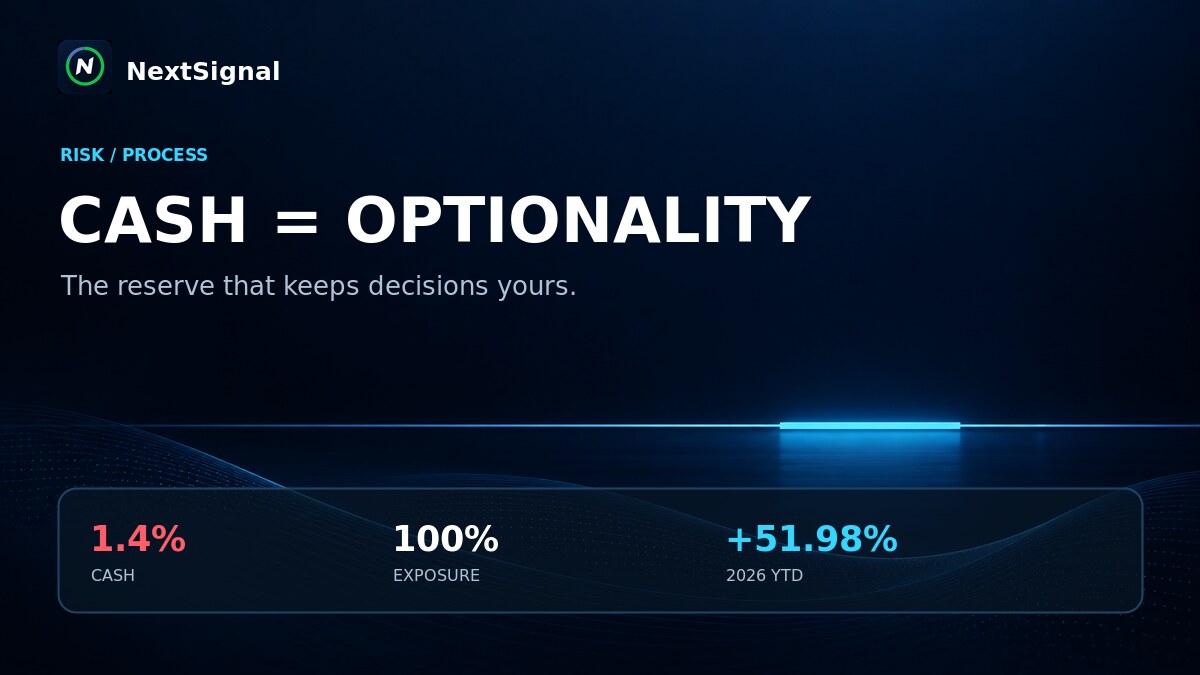
Cash ist keine Prognose: Warum Liquidität Handlungsfreiheit schafft
Das CaptMarvell-Portfolio liegt 2026 bei +51,98 %, hält aber nur rund 1,4 % Cash. Warum Liquidität kein Markt-Timing, sondern ein Prozesswerkzeug ist.
Read article Stocks
Broadcom im Fokus: Wenn Strom zum neuen AI-Engpass wird
Morgan Stanley erwartet bis 2028 eine erhebliche Stromlücke bei US-Rechenzentren. Warum Broadcom vergleichsweise gut positioniert sein könnte – und wo das Risiko in der Lieferkette liegt.
Read article AI & Technology
AI liefert ROI – doch der Sprung vom Pilotprojekt in den Betrieb stockt
Fast drei Viertel der befragten Unternehmen melden positive finanzielle Resultate mit AI – doch weniger als ein Drittel kommt über Pilotprojekte hinaus. Warum Umsetzung jetzt zum entscheidenden Engpass wird.
Read article