
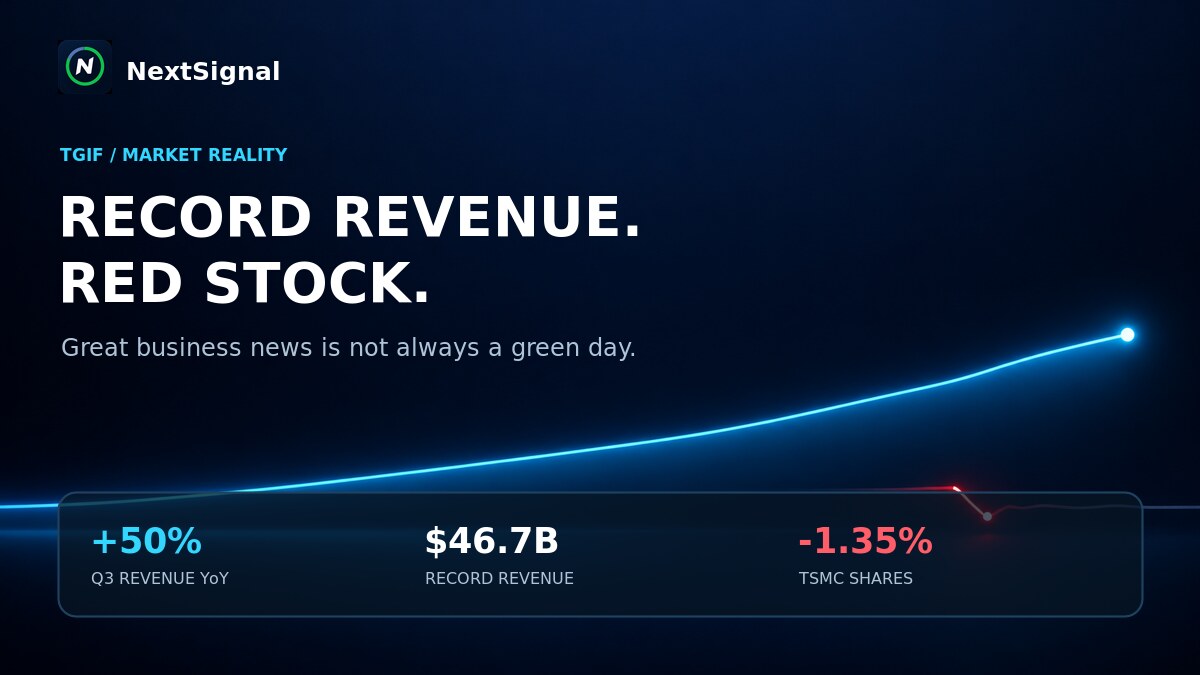
TSMC grew quarterly revenue by 50% to a record. Why the stock still finished red and what investors can learn about expectations.
TSMC reported a new third-quarter revenue record of T$1.49 trillion, or $46.71 billion. That represents 50% year-over-year growth and exceeded the LSEG market estimate of T$1.46 trillion. September revenue alone rose 54.6%. Source: Reuters, October 8, 2026
And the stock? It still finished the Taiwan trading session 1.35% lower.
The sequence matters: the decline came during the broader market selloff before the revenue figures were released, so the report did not cause the drop. Even so, the combination illustrates something very typical about markets.
Good news does not automatically create a green day
A stock price never evaluates one announcement in isolation. It also reflects:
- what investors already expected,
- how demanding the valuation has become,
- what interest rates and risk sentiment are doing,
- and whether the next outlook can clear an already high bar.
At TSMC, the fundamental trend is difficult to miss. Demand for advanced chips used in AI applications continues to drive production. The company supplies customers including Nvidia and Apple and remains a central manufacturing platform for the global semiconductor industry.
But that strength also raises expectations. After a gain of more than 60% this year, a record alone does not necessarily guarantee another green session.
The more important date is still ahead
The revenue release did not include full details on margins, earnings or forward guidance. TSMC will publish its detailed quarterly results on October 15, 2026. Source: TSMC Investor Relations
Three questions will matter most:
- Is demand for advanced nodes and AI chips still accelerating?
- How are margins and capital expenditure developing?
- What does management signal for the fourth quarter and 2027?
My TSMC position is currently up approximately 6.9%. The record revenue supports the operating picture, but it does not remove the need to watch expectations and valuation.
The TGIF lesson: a strong company can have a weak trading day. Both can be true at the same time.
Year over year
Third quarter 2026
Taipei, before the release
Record numbers explain the business. The share price reflects what the market had already expected.
Operating strength and short-term price action can diverge. What matters is how much expectation is already embedded in the price.
These companies could also benefit from this theme.
TSM fully analyzed
AI score, trend, RSI and valuation at a glance.
Simulate investment
Calculate how an investment would have performed historically.
Discover NextSignal
All stocks with score, trend and AI assessment at a glance.
Related articles
Behind the Trader: Was würde mich umstimmen?
19 Positionen und eine entscheidende Frage: Welche Fakten würden eine AI-Investmentthese widerlegen?
Read articleMarvell und der AI-Engpass: Warum 3,2T-Verbindungen zählen
Schnellere GPUs brauchen schnellere Verbindungen. Was Marvells neue AI-Chips leisten und welche Risiken Investoren beachten sollten.
Read article ETF
Ein ETF ist nicht automatisch ein Sicherheitsgurt: Versteckte Tech-Überschneidungen
Warum Value-, internationale und Halbleiter-ETFs das Klumpenrisiko sehr unterschiedlich beeinflussen – mit Marktbeispiel vom 15. Oktober 2026.
Read article